Mapouka ESSAYS
These works operate as visual essays rather than linear texts. Beginning with Mapouka as a choreographic ancestor to contemporary twerking, the collages layer academic writing, fragmented imagery and distorted typography. Institutional knowledge and embodied knowledge are placed in collision rather than hierarchy.
The form refuses clarity. Meaning is produced through layering, repetition and disruption. The inclusion of the lyric “I don’t think you’re ready for this jelly” from Destiny’s Child’s “Bootylicious” introduces Black popular culture as both archive and tension point. The lyric shifts between confidence, humour and confrontation, becoming a challenge to the viewer: not only whether you understand, but whether you are ready to confront what has historically been projected onto Black women’s bodies.
The second collage develops the idea of twerk cartographies. Rather than mapping land, it maps movement, tracing how dance travels across West Africa, the Caribbean, South America and North America, from Abidjan and Kingston to New Orleans and Atlanta, and into digital spaces.
This leads to the question:
Who has nyash currency?
Here, nyash refers to the Black feminine body, specifically the buttocks as a site of cultural meaning and contested value. The term, rooted in Nigerian Pidgin English, has travelled across West African and Caribbean diasporic spaces. In the work, nyash becomes a way of considering how value is projected onto Black women’s bodies, how it is consumed and appropriated, and how it can also be reclaimed as self-possession and expressive agency.
The work asks who is allowed to profit from Black cultural production and embodied knowledge, who is celebrated, and who is erased or ridiculed. It also considers how movements rooted in Black diasporic histories are detached from their origins and recoded as trend, spectacle or “primitive”.
West African spiritual materials and objects, including cowrie shells, are incorporated throughout the collages. Historically, cowries functioned as currency as well as spiritual and cosmological objects, carrying multiple forms of value. Within my practice, they have become a visual language of rhythm, ancestry and exchange, connecting embodied movement to systems of meaning that predate colonial economic structures.
One collage centres an image of Josephine Baker performing the banana dance, often discussed in relation to longer histories of Black dance and the moving buttocks. Layered with text from The Batty Politics: Toward an Aesthetic of the Black Female Body, the image considers the Black female body as a site of aesthetic construction, projection and contested visibility. Baker’s performance is placed within longer histories of racialised spectatorship, cultural circulation and embodied resistance.
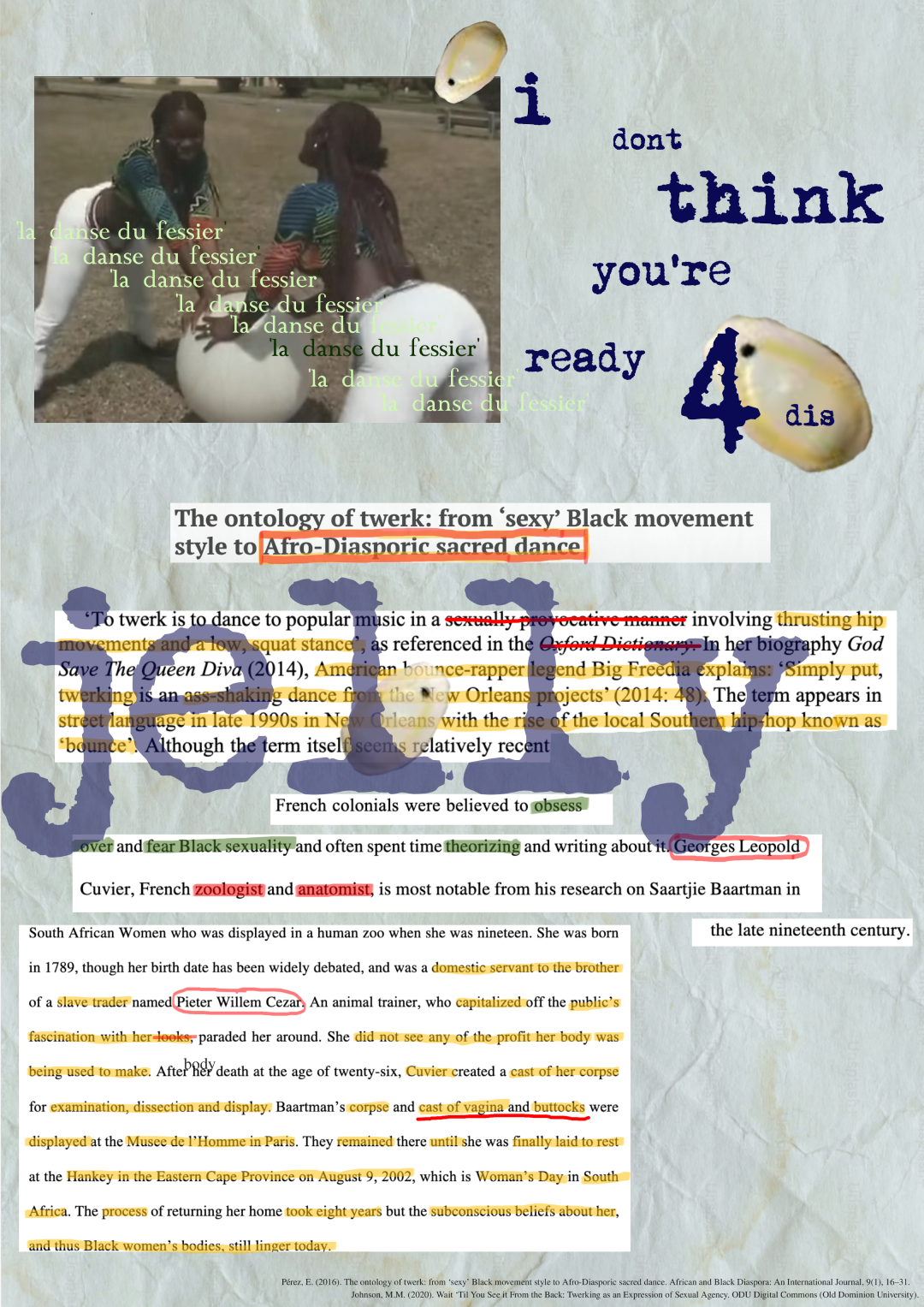
I dont think you’re ready for this Jelly
Abstract essay (collage on Photoshop)
Academic text
c.2025
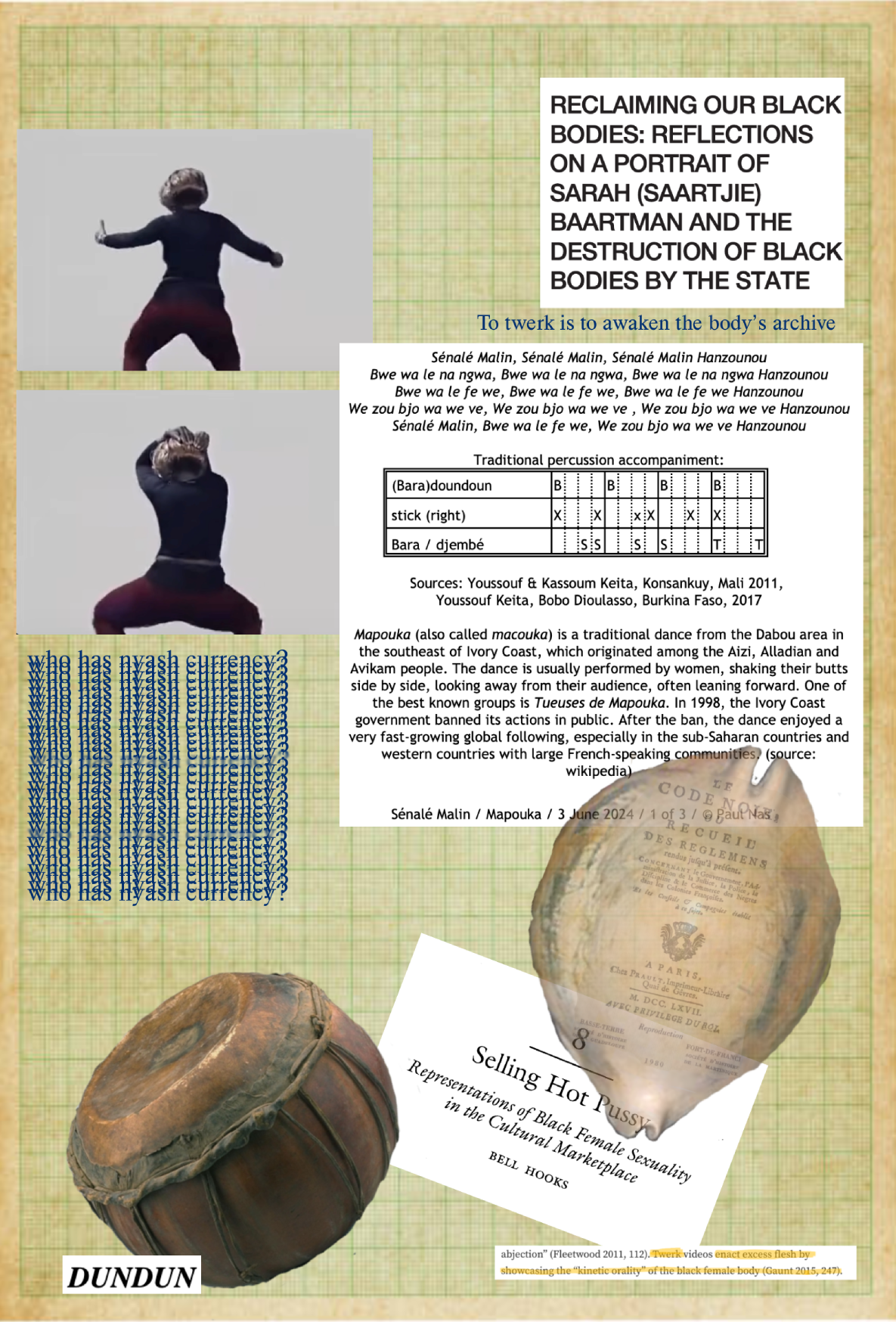
Twerk Cartographies
Abstract essay (collage on Photoshop)
Academic text
c.2025
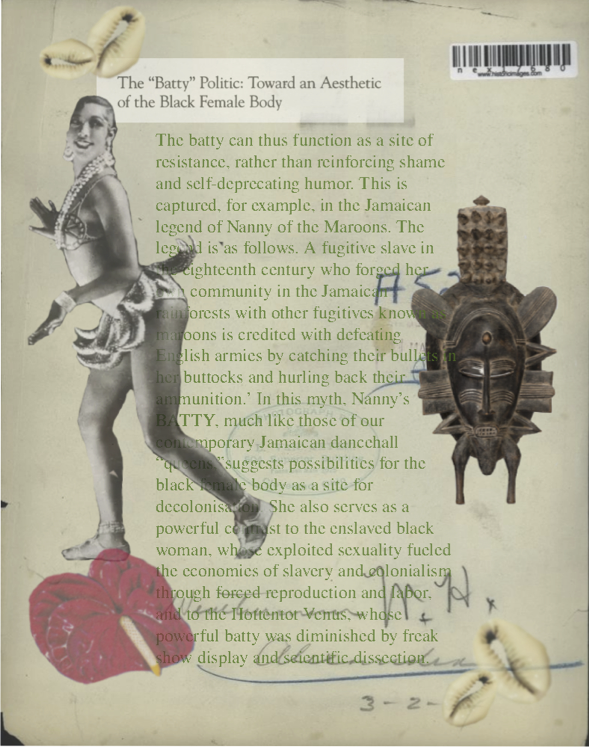
Batty Politics
Abstract essay (collage on Photoshop)
Academic text
c.2025